If it feels like remedial, it's not lymphatic.
JE
Lymphatic massage has become one of the most talked-about wellness treatments in Australia right now. And with that popularity has come a wave of techniques being offered.
---------------------------------------------------------------------------------
Where did lymphatic drainage massage come from?
Manual lymphatic drainage was developed in the 1930s by Danish physiotherapist Dr Emil Vodder and his wife Estrid. Dr Vodder noticed that many of his clients with chronic colds and sinus conditions had swollen lymph nodes in their necks. Despite medical convention at the time advising against touching the lymph nodes, he began experimenting with gentle, rhythmic massage techniques on these areas and found remarkable results.
By 1936 he’d developed a systematic technique built on one fundamental principle:
That the lymphatic system responds only to very light, precise, directional pressure. Too much pressure collapses the vessels, and wrong direction works against the body's natural flow. Sequence matters as much as touch.
His method, known as the Vodder technique became the foundation of what we call Manual Lymphatic Drainage, or MLD. It has since been refined and taught through accredited clinical programmes worldwide and is used in hospitals, cancer care, post-surgical recovery and specialist wellness clinics.
So, if your massage feels like any of the following:
1. Remedial
2. Soft tissue
3. Deep tissue
4. Fast brushing
5. Back and forth movement – non-directional
IT IS NOT LYMPHATIC DRAINAGE!
---------------------------------------------------------------------------------
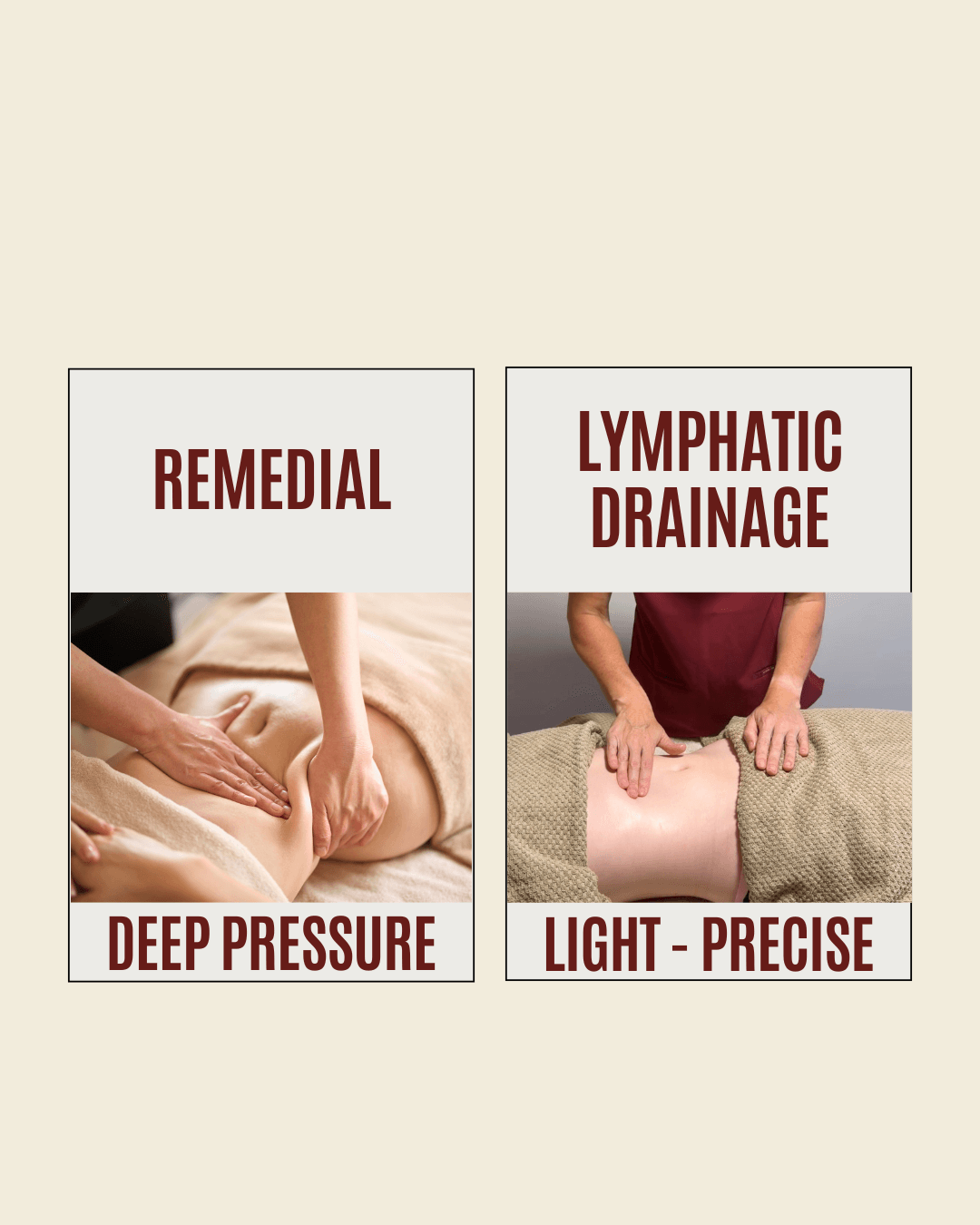
PRESSURE – why less means more
Lymph vessels sit just 1–2mm beneath the surface of your skin - just below the epidermis, well above the muscle layer.
Lymph vessels have one-way valves. When gentle directional pressure is applied to the skin above them, it acts like a vacuum, the pressure opens the valve and pushes fluid forward into the next vessel. As the pressure is released, the chamber draws fluid in behind it and the valve closes. This rhythmic sequence is what moves lymph fluid and debris toward the lymph nodes.
This is why precise directional pressure is everything and why deep pressure achieves the opposite. Rather than opening the valves and moving fluid forward, deep pressure simply compresses the vessels from above, pushing fluid out sideways or deeper into the tissue. The diagram below shows exactly this, fluid displaced, not drained. No direction. No effective drainage.
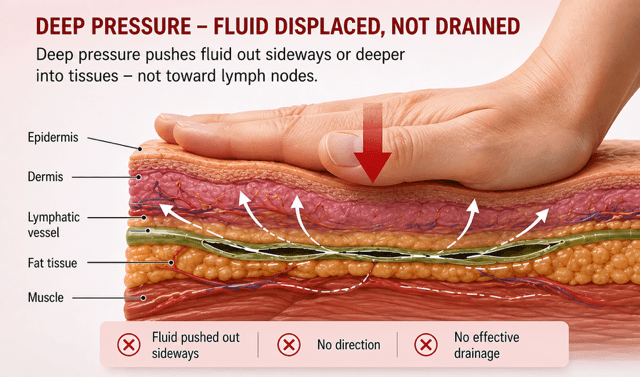
The pressure needed to move lymph fluid correctly is genuinely feather-light — about the weight of a coin resting on your skin. Deep pressure does not reach the lymphatic vessels. It compresses them. If you are compressing muscle, you are already far too deep.
This is also why techniques such as brushing back and forth have no effect on the lymph vessels. Moving the skin in both directions simply moves fluid within the vessel without ever clearing it. The one-way valve requires directional movement — always toward the lymph nodes, never against the flow.
---------------------------------------------------------------------------------
DIRECTION & SEQUENCE
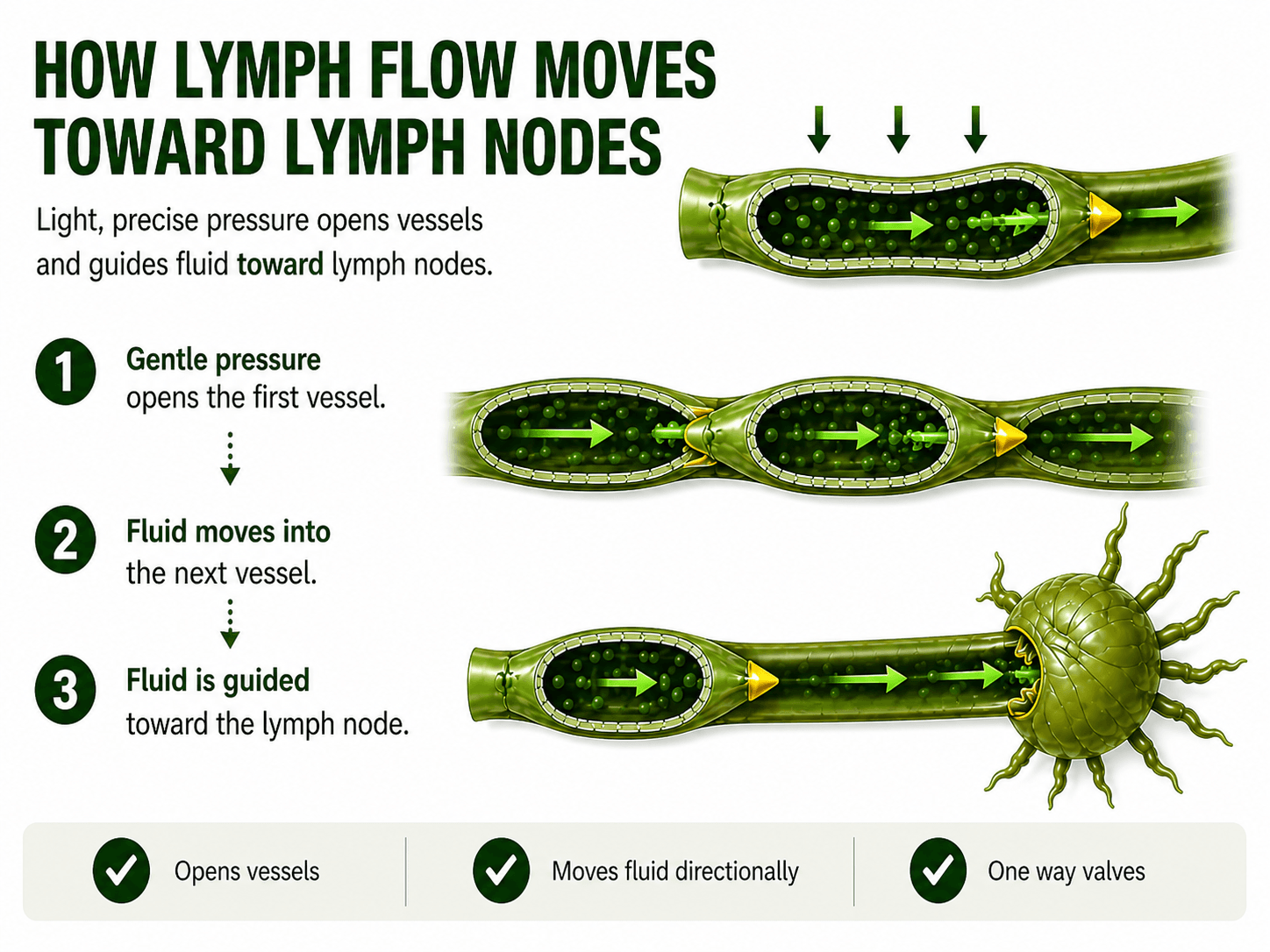
Unlike the circulatory system, the lymphatic system has no heart and no pump. Fluid moves in one direction only, vessel by vessel, guided by those one-way valves toward the lymph nodes.
Every region of the body drains to a specific group of lymph nodes. The legs drain toward the groin. The arms drain toward the armpit. The face and neck drain toward the collarbone. Everything ultimately flows toward the large collecting vessels that return clean lymph back into the bloodstream.
A skilled lymphatic therapist doesn't simply apply light pressure and hope for the best. They work in a deliberate sequence, always clearing the destination nodes before working the tissue that drains into them, and always following the anatomical pathway the body already uses.
Working in the wrong direction, starting in the wrong place, or skipping the sequence doesn't just reduce results. It works directly against the system you are trying to support.
What this means for Lymph & Body clients
As you’ve read, the difference between a treatment that genuinely moves lymph and one that simply feels relaxing comes down to three things - pressure, direction and sequence. All three must be correct. None can be substituted with deeper pressure or faster strokes.
At Lymph & Body we use a three-step approach within every zone of the body:
1. Clear the drainage points So fluid has a clear pathway to drain toward before any tissue work begins.
2. Targeted soft tissue work To release tension, increase local circulation and mobilise cellular debris, excess proteins, metabolic waste products and stagnant interstitial fluid that have become trapped within the tissue fibres, making them accessible to the lymphatic capillaries.
3. Precise lymphatic drainage To collect and direct that mobilised fluid through the correct anatomical pathways, into the lymph nodes, where it is filtered and either returned to circulation or eliminated from the body.
This sequence is not guesswork. It follows the physiology of how the lymphatic system actually works.
Not remedial. Not deep tissue. Not guesswork. Correct lymphatic technique - every time.
If you are in the Redlands area and ready to experience the difference, we would love to see you.
Book or learn more at lymphandbody.com 🌿
Lymph & Body | Specialised lymphatic drainage | Mount Cotton, Redlands QLD. https://lymphandbody.com/